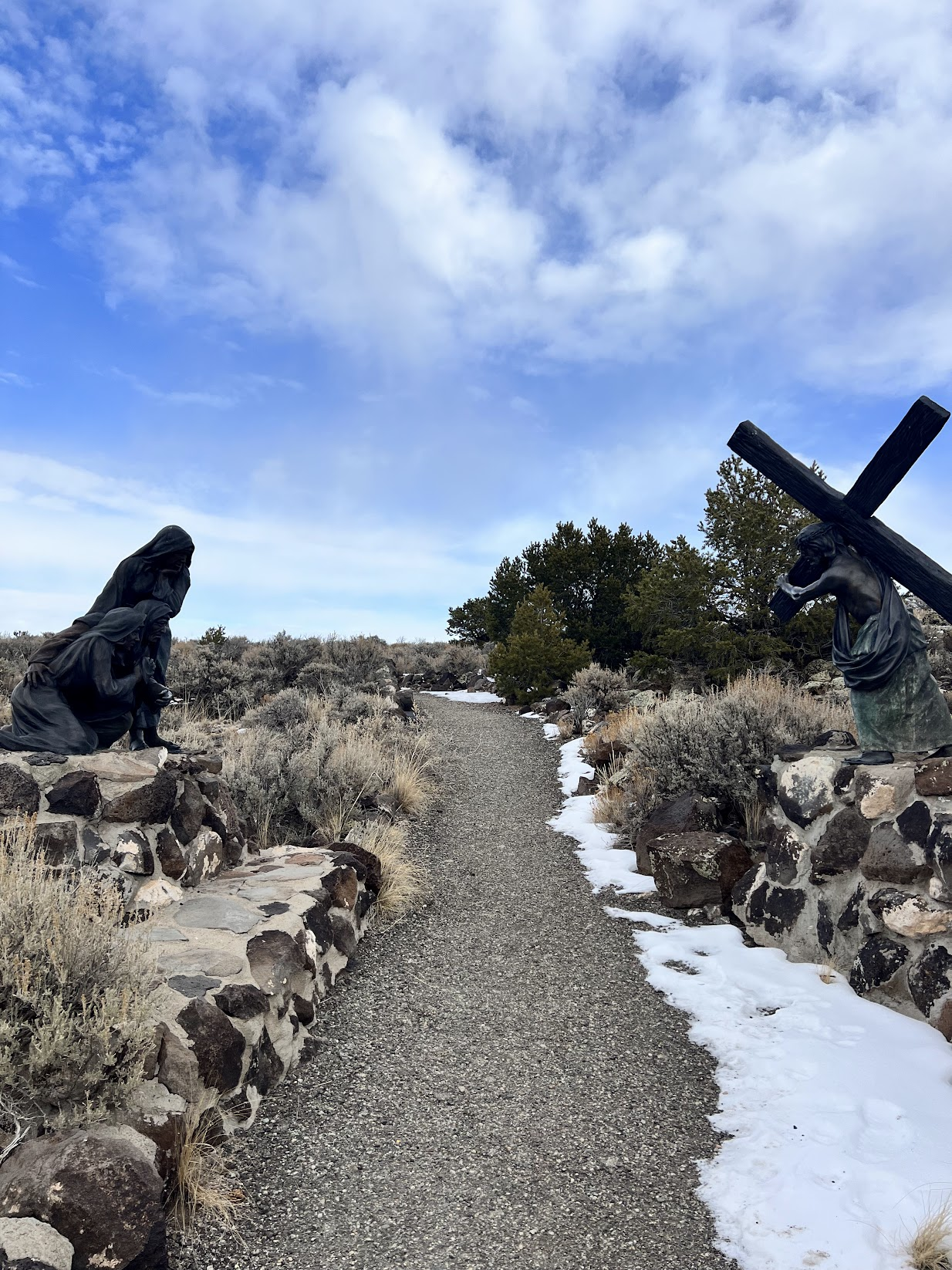
Photo by Mitch Teemley Why do we need to believe in him? One night many years ago, I ran into a young woman “witnessing” on a street corner. 248 more…
Why Do We Need to Believe in Him?
Category: Uncategorized
-
-
Pip: Pastor Goforth is preaching out of Luke 18, where Jesus meets a man who has done everything right and still walks away sad — which, honestly, is a mood.
Mara: This episode follows that encounter into some real territory: what it costs to follow Jesus, what it means to actually leave something behind, and why children might understand faith better than rulers do.
Pip: Let’s start with the wealth we carry and what Jesus asks us to do with it.
Where Is Your Wealth? Lay it Down
Mara: Luke 18 sets up a contrast that drives this whole post — children coming to Jesus with nothing, and then a wealthy young ruler arriving with a very specific question: what must I do to inherit eternal life?
Pip: And the post points out that “what must I do” is already the wrong question. Children don’t come with a to-do list. They come with excitement, expectation, faith, and humility.
Mara: Jesus meets the ruler where he is, runs through the law, and then in verse 22 delivers the line the post anchors everything on: “you still lack one thing — sell all you have… then come follow me.”
Pip: That word “lack” is leipo in the Greek — to fall short. The ruler had kept the law and still came up short, not because of what he hadn’t done, but because of what he wouldn’t release.
Mara: And the post broadens that out deliberately. Wealth here isn’t only money. It’s property, possessions, competence, confidence — anything we hold onto that makes it harder to come like a child. The post puts it plainly: it’s easier for the down-and-out to come than the up-and-out.
Pip: Which is a quietly uncomfortable observation, because most people reading a sermon blog are not the down-and-out.
Mara: The post then works through what leaving everything actually requires. Peter says, look, we left what we had — and the post notices he’s almost keeping score. As long as you’re tracking what you gave up, you haven’t really left it.
Pip: There’s a detail from John 21 here worth catching: after the resurrection, Peter and the disciples went back to their boats. Jesus showed up and gave them a fresh call — and that, the post argues, is when they truly left everything, all the way to death.
Mara: The post closes with a disarming move. The disciples didn’t understand where following Jesus would lead — the betrayal, the death, the rising. And the post imagines Jesus responding: “What did you understand?” “You said follow me.” “Then do that, and leave the rest to me.”
Pip: Excited, expectant, humble, faith-filled — coming like a child is the whole posture, not just a metaphor for the young.
Mara: The question underneath all of this is what we’re actually gripping when we say we’re following — and whether we’ve scored it or surrendered it.
Pip: Come back next time. There’s more Luke 18 ahead, and Jericho is just around the corner.
-
Luke 18, Jesus has a several famous encounters in this and chapter 19. But I started at what we call the “Rich Young Ruler”.
This story is in the midst of the ministry years. After this, he heals a blind man, then he enters Jericho and meets that diminutive man named Zacchaeus.
Before this, Jesus tells a parable showing that if we persist in prayer, we can know that God grants justice. Then in v9 he told a parable to some who “trusted in themselves” and took pride in their own goodness while looking down on others who didn’t live up to their self-created standards.

Then Jesus encouraged children coming to him. “Let the little children come to me because the kingdom belongs to such as these.” He takes it a step further to say that whoever does not receive the kingdom like a little child will never enter it.
In the midst of that, a young man and a ruler, asked, Good teacher, what must I do to inherit eternal life?
Now, if he was a “ruler”, then he wasn’t too “young”, as that’s a relative term. He wasn’t aged, but was old enough for authority, and asks, what must I do?. That of course is the wrong question.
How do little children come?
- With Excitement
- With Expectation
- With Faith
- With Openness
- With Humility
Jesus said, if you want a “to do list” – you have the law. “I have kept all these from my youth”. We all have a list of what we’ve done or tried to do… and yet, we ALL come up short of the glory of God.
Then v22 When he (Jesus) heard this, he told him, ‘you still lack one thing’ (leipo = fall short) sell all you have… then come follow me.
It is not what we DO, but who we follow and how.
If you read on, the disciples say, this is hard so the disciples wonder, then who can be saved?
- Jesuus answers, what is impossible with man is possible for God.
Yes, it is hard to follow Jesus, particularly when we have “wealth”, whether that is money, property, possessions, competence, or confidence – those things make it hard to follow Christ. I’ve often said it’s easier for the “down-and-out” to come than the “up-and-out”. They often have the hardest time coming to the Lord.

Jesus flips those two words. The root word for ability is dynamai (looks like dynamite) and means to be able. The word then “possible” comes from that root and is dynatos – possible/powerful. Yet if you add “a” to the front, adynatos = impossible. God DOES flip the script from impossible to possible.
- This one thing you lack… you are holding on to your own competency…
- Sell it all – Lay It Down… and
- Come Follow Me
That man went away sad… why? Because he wasn’t willing to comes as a child.
Children, generally, don’t have wealth, don’t have influence, but they come with excitement, expectation, faith, and humility, desiring to be touched by God.
Peter said, “Look, we have left what we had and followed you.” You can almost see him making a “check mark” in the sky.
Yes, Luke 5:11 they pulled up their boats on short, left everything, and followed him.
But when we “Leave Everything…” – LEAVE IT. Let it go. Stop Keeping score. Don’t expect reimbursement. As long as I keep score, I haven’t “LEFT” it. Jesus said to the man, “sell it all”… then “give away the profit”.
Interestingly, in John 21, after the resurrection, Peter and the disciples still had access to their boats and went back to fishing – but if you read it, Jesus came them a fresh call and commission – Then they TRULY Left Everything and gave the fullness of their lives to him, to the point of death.
Jesus tells them to rest assured that no one who has left everything – people, possessions, purposes, priorities, posture, anything – will be repaid much more now and in eternity.
Then he tells them WHERE following him will lead. It will result in the fulfillment of Psalm 22 and Isaiah 53, and so much more, as he will be… handed over… mocked… insulted… spit on… flogged… killed… but will rise on the third day…
v34 they understood non of these things… they did not grasp what was said…
I think sometimes, we don’t understand, so we do not go.

“I don’t understand this, Lord.”
I can hear Jesus saying, “What DID you understand?”
“Well Lord, you said, ‘follow me’.
“So then, DO THAT, and leave the rest up to me.”
Here I come Lord… excited, expectant, humble, faith filled, following…
Touch me Lord.
-
Pip: There is a particular kind of sermon note that starts with a king dying and ends with the cosmos, and Pastor Goforth has written one of those.
Mara: This episode follows a single extended reflection on Isaiah 6 — the vision, the confession, the call — and how a moment of personal grief becomes the doorway to encountering God.
Pip: Let's get into it.
I Saw The Lord — Isaiah 6 and the Shape of Encounter
Mara: The post opens with a disarming admission: most of us will never see God with our eyes or hear his voice with our ears, and the question it sits with is what it actually looks like to "see the Lord" through Scripture and Spirit.
Pip: And the framework offered is five words — Posture, Preparation, Provision, Persistence, Presence — which sounds like a conference handout until you realize the post is using them to trace something genuinely personal.
Mara: The anchor passage is Isaiah 6, and the post sets it up through the detail most readers skip. Isaiah and King Uzziah were likely related — uncle or cousin — and Uzziah reigned for fifty-two years before a catastrophic fall: he attempted a priestly sacrifice forbidden to kings, and God struck him with leprosy. His final days were spent, as the post puts it, "in separation, disease, and disgrace."
Pip: So when Isaiah says "in the year that King Uzziah died," he is not giving us a timestamp. He is telling us he was grieving.
Mara: That's exactly the point the post makes. It notes the phrase is "in the year" — not the day, not the week — because loss takes time. Isaiah came to the temple humbled, and what he found there is the famous vision: the Lord seated high and lifted up, seraphim calling out, the room shaking.
Pip: And his first response is not awe. It is collapse.
Mara: The post quotes directly: "Woe is me… I am ruined." And then the confession — "I am a man of unclean lips, among a people of unclean lips." The post wonders honestly whether those unclean lips had been asking hard, accusatory questions during the year of grief.
Pip: Which is where the post gets genuinely vulnerable — there is a story about losing a close friend, sitting in an office, and sensing a quiet question: are you going to figure this out? The answer was no, and the pivot that followed was an invitation simply to worship alongside the friend who was already doing exactly that.
Mara: The sequence the post traces is deliberate: see the Lord, then see yourself, then confess — and only then does the voice come. "Then I heard the Voice of the Lord… Who will go for us? I said, Here I am, send me." The post reads that progression into Psalms 121 through 124 as well, a chain of lifted eyes and arriving help.
Pip: Look up, look in, listen, respond — that is the post's closing line, and it earns it.
Mara: The through-line here is that encounter with God tends to move through grief and honesty before it arrives at commission.
Pip: Which means "Here I am, send me" is not a brave opening line. It is what comes out the other side of something harder.
-
Pip: Pastor Goforth is here to talk about the World Cup, and somehow also about everything — life, faith, dirt fields with large rocks, and why Americans keep asking when the scoring starts.
Mara: This episode follows one extended reflection on soccer, its global reach, and what the beautiful game turns out to have in common with how a life is actually lived. Let's start with the game itself.
O Jogo Bonita — What Makes Soccer Beautiful
Mara: The post opens with a question worth sitting with: what actually makes soccer beautiful, and why does that beauty seem to elude so many American sports fans?
Pip: The answer lands somewhere unexpected. Here is the line that pulls the whole piece together: "Futbol, Football, or Soccer is a Beautiful Game because it is much more like life. Anyone can compete. We must work together, think proactively, get in position, pay attention, be patient, stay at it when you are tired, just like life."
Mara: So the upshot is that the game's structure — ninety minutes of continuous play, low scoring, sustained effort — is not a flaw to be fixed. It is the point. The doing is the reward, not the scoreboard.
Pip: Which puts American sports culture in an interesting light. The post walks through baseball, football, basketball, hockey, and even pro wrestling, noting that each time a sport felt too slow or too unpredictable, someone added a faster payoff. Three-point shots, slam dunks, choreographed fights. We kept asking the game to come to us.
Mara: And soccer simply does not do that. Ninety minutes of play, maybe one goal, and the crowd sings the whole time anyway. The post makes a point about World Cup national anthems that is genuinely striking — at other sporting events, the anthem is performed at people. At the World Cup, the teams and fans sing it themselves, together, out loud.
Pip: There is something almost embarrassing about that contrast, and the post does not soften it.
Mara: The piece also draws on personal history — decades of playing, coaching youth teams, and carrying a soccer ball across four continents on mission trips, where it consistently opened doors that other approaches could not. The game as a shared language before any words are exchanged.
Pip: It closes on Colossians 3:23 — whatever you do, do it from the heart, as for the Lord. The beautiful game, it turns out, is also a sermon illustration that actually works.
Mara: And the invitation at the end is simple: if you have not watched, watch. Not to become a fan, but to understand what has the world so completely absorbed.
Pip: Patience, sustained effort, small victories inside a long stretch of doing — as life metaphors go, that one holds up.
Mara: More from Pastor Goforth next time. The game, apparently, continues.
-
No one has greater love than this: to lay down his life for his friends. You are MY friends if you do what I command you (John 15:13-14 CSB)
John 15 is so full – so powerful. Jesus is squeezing so much teaching in this night before his crucifixion.
In John 13:34-35, he has already said, A new commandment I give you… love one another… as I have loved you… by this all will know you are my disciples…
Now, he has talked about “abiding in him” 15:5 that’s where life and fruitfulness exist for the “branches” The Vine is the source, the Branch gets life from the Vine.
Then you get down to verse 13, and we often read this looking back and knowing what Jesus died for us, but I’ve often pointed that Jesus didn’t just “show up” and die, no, he came and LIVED, gave up his LIFE, not just his death.
So, is he calling us to consider how we live? Is he saying we should live lives surrendered to the better FOR someone else?
Yes
Oh wait, my greatest love is laying down my life, for my friends. philos = beloved, dear one – Ok, I can do that – live surrendered to my friend…
That’s the problem, when we pick and choose verses.
Laying down your life for your friends, got it…
Wait
v14 you are MY friends if you do what I command you…
uh-oh – What has he commanded? Back up to all of this chapter, but even if you take a few verses…
v9 as the Father has loved me, I have loved you (1) Remain in my Love – if you keep my commands you will remain in my love…
Is he saying that when I do not do what he says I’m NOT staying in his love?
He continues, Just as I have kept my Father’s commands and remain in HIS love… Well… go to John 5:19 and Jesus said he was unable to do anything on his own… only what the Father does… the Son does…
Then in John 15:11 says there is Joy in this… that my joy may be in you and your joy may be complete…
Joy comes in knowing and doing what Jesus says, what the Father says
(2) v12 this is my command, love one another, as I have loved you…
Well, he keeps saying this doesn’t he?
Romans 5:8, Paul teaches us that Jesus demonstrated / proved his love in that while we were sinners, separated from God, he died for us.
1 John 3:16 this is how we know what love is: He laid down his life for us… we should lay down our lives for our brothers…
Well Now… this is more clear and more hard… but I still can just do it for my “friend” right?
Well… sort of… Jesus said, you are MY friends IF you do what I have commanded…
What did he command? Love one another and remain in my love…
Jesus’ disciples had come a long way here in John’s Gospel. From chapter one as seekers, to followers, to followers, to disciples, to servants, and now toward friendship.
v15 I have called you friends… have made known to you what I heard from my Father. 16 you did not choose me, I chose you.
I’ve always thought, as someone who had been picked LAST sometimes on the playground, blessed to know, Jesus picked me FIRST.
So, when I choose to obey, to love, to show love, do love, then feel love… it is not about me, and not even about those… it is about being a Friend of Jesus!
You are my beloved, dear one, friend if you do (poieo = to make, fashion, do, accomplish) what I command you
Yes, Lord, I love you, I am grateful for the opportunity to be more than a servant, but a friend.
This is Love – lay down your living life (psyche = soul, breath, life)
Oswald Chambers in speaking on this
- “we are not made for brillant moments, but we have to walk in the light of them in ordinary ways”
- “If I am a friend of Jesus, I have deliberately and carefully to lay down my life for him”
- “Salvation is ‘easy’ because it costs God so much, but the manifestation of it in my life is difficult
Alright then, child of God, Servant of God, Let’s grow into Friend of God.
-
Sometimes we have on blinders or aren’t processing information with a full picture of reality or proper perspective… then, I saw this verse today, “Do you pursue great things for yourself?”, and I thought, “I’m supposed to right?”
Well, not necessarily… I need to First, pursue God, pursue his will, pursue his purpose, pursue his Kingdom… Matthew 6:33 immediately comes to mind… but I get ahead of myself…

Back there in Jeremiah 45, just a very short chapter between other statements, pronouncements, regarding the wickedness of Judah, in the midst of a time of judgment that is coming for their failure to follow and worship the Lord. There are long chapters and declarations from God, but only five verses right here in 45.
In the previous chapter, it talks about their false worship of idols and buring incense (prayers) to “the Queen of Heaven” which was a false goddess, Ishtar or Ashtarte. It also corrects the husbands for ignoring this and failing to lead their families correctly.
Jeremiah 44:22 The Lord can no longer bear your evil deeds and the detestable acts you have committed.
Then, the Lord comes to Jeremiah’s scribe – Baruch. In verse 1 we see that Jeremiah, as was his practice, was dictating the Word of the Lord to Baruch. Imagine this, as Baruch is writing down, right to left, just whatever Jeremiah says. So, Jeremiah is speaking, Baruch is writing, This is what the Lord says… to Baruch 3 You have said, “woe to me, because the Lord has added misery to my pain! I am worn out with groanings and have found no rest.”
Jeremiah is saying this, v1 says, he is dictating it to Baruch… and it’s ABOUT Baruch…
I wonder if Baruch is thinking, while he writes… “is he talking to me, about me? No, must be about Judah…”
But Jeremiah is speaking from God about Baruch’s private nightly weeping and crying over all that is happening. Perhaps Baruch had been praying from Psalm 6:6 “I’m weary from my groaning; with my tears I dampen my bed and drench my couch every night.”
v4, This is what you are to say to HIM: ‘this is what the Lord says: “what I have built I am about to demolish and what I have planted I am about to uproot – the whole land.
“Wait, is God speaking to Me?” (Baruch)
Then v5 But as for you… “oh he is talking to me” uh-oh
Do you pursue great things for yourself? “Is this a loaded question? Is this a trick question? I’m supposed to right?”
Then the Lord says, through Jeremiah, TO Baruch – Stop Pursuing! – This word means “to discover, attempt to do, possess, demand, require, search, request“. The Lord says, “Stop that!”
We need to know when and what God is saying. What do you seek?
Remember then Jesus in the “Sermon on the Mount” Matthew 6:25+ he says, Don’t worry about your life… what you eat… what you will wear… Consider the birds of the sky… Observe the wildflowers of the field… God clothes the grass… don’t worry… your heavenly Father knows that you need them… BUT Seek FIRST the kingdom of God and his righteousness, and all these things (the stuff we worry about) will be provided for you… therefore do not worry about tomorrow… tomorrow will worry about itself…
Back to Baruch – he was shedding tears, groaning, and it seems wanting to take things into his own hands… Pursuing Great Things for himself… and God says, Stop Pursuing…
Seeking to achieve great things is not wrong or bad, but it can be useless if you don’t know what God is doing, and where things are heading. God says, “I am about to bring disaster on humanity… but I will grant you your life, protected like ‘spoils of war’ wherever you go.”
I got a picture in my head just know of trying to fix and lay out the most beautiful meal, or encampment, right next to the seashore where waves are crashing and tide is coming in, it might look good, but in a minute, it’s going to be washed away…

We need to pursue God first, his kingdom, and do what he says without fear, but don’t be caught in needless efforts stacking up “great things” where God may be about to send / allow a storm to wipe it all away.
He was telling Baruch… things are about to get tough, so don’t waste your energy in the wrong things, but know I’ve got you in the midst of it all.
-
As I read this morning, this caught my attention. So, I backtracked and across the page on my digital reader was v28 – Peter began to tell him, ‘Look, we have left everything and followed you’.
Look – it’s a word I’ve seen a lot as I finished preaching The Revelation. It is

in Revelation as Jesus says, “look, I am coming soon…” It is also in 2 Corinthians 5:17 when it states that In Christ… a new creation… old has passed away, SEE (look) all things are new. It’s a word, idou that means to behold, pay attention, and here, Peter is using that word as he talks to Jesus.
Often times, we look at our experiences through jaded perspective and think that perhaps God doesn’t see it as he should.
Jesus had just encountered the “Rich Young Ruler”, in Mark 10, and then explained to his 12 Students, how hard it is for those with wealth to enter the Kingdom. He told them it is easier for a camel to go through the eye of a needle.
Really? Well, understand he is referring to a small sheep gate, just big enough for a sheep to pass through, and though not impossible for a camel, was difficult. And the disciples reply, then who can be saved.
Jesus replies… all things ARE possible with God.
That’s when Peter began to TELL him… It’s always funny when we want to tell God stuff – but to Peter’s defense – this word – lego – does mean to “agree” – So, Peter was just sort making an affirmation – “yes Lord, you are right” and of course “we are on the GOD-side.
But it strikes me that he says, Look – idou – pay attention. Lord we have LEFT – aphiemi = leave, forgive – “we have turned around” – from all and followed – akoloutheo = take a road – “we have made a 180 and taken your road Lord.
And then Jesus says, Truly – AMEN – those who aphiemi – left – anything for MY SAKE and for the SAKE of the gospel…
“For the Sake” – heneken = on account of – I do think it is important that we always check our reasons for the big sacrifices we make… but be SURE – Don’t Worry – God keeps a good “ledger”, and his return is always greater profit.
v30 – will receive 100 times more… NOW… with persecution… wait what?… and eternal life in the age to come
v31 but many who are first will be last, and the last first…
God’s accounting is different than ours, but always to eternal overflow.
All of that, and THEN for me, v32 is what caught my eye to start this today. They were on the road, going up to Jerusalem, and Jesus was walking ahead of them. The disciples (the 12) were astonished, but those who followed (other followers) were afraid. Taking the Twelve aside, he began to tell them the things that would happen to him.
Here we are, in 2026, a few weeks away from Celebrating his Death. So, too was Jesus heading Up to Jerusalem to Die for Our Sins.
Fear and Astonishment
Jesus tells them that he will be handed over, mocked, flogged, killed, and will rise after three days. I believe Jesus is always telling us that “Following me is Amazing and Frightening”
We have plans… and he says, it will be better than you can imagine, and more difficult than you assumed.
Then immediately, James and John are asking for favored status in his Kingdom. Jesus tells them “you have know idea what you are asking”. Then think they do, and he affirms, yep you WILL go through much of what I’m going through… but…
Then he redirects their desires, big plans, and aspirations.
v44 whoever wants to be first among you, will be slave to all
v45 even the Son of Man did not come to BE served, but to serve, and to give his life as a ransom for all
Refocus our Ambition.

Jesus was heading up to Jerusalem to die, and he was leading them, knowing what he was about to face. Knowing all we will face, he still is in the lead. Be amazed, be not afraid, lead others, always knowing that we are just following him.
Jesus was going to Jerusalem, fully committed, not trailing sadly behind, but leading triumphantly in front.
The Reality is Frightening…
…but the Return is Forever in our Favor
-

Ever had sun so bright you couldn’t see?
skandalizo – even though I’m not a “Greek Scholar”, we can look at that word and get a good idea what it means. It looks like “scandal” – and literally means, “to put a snare in the way, cause to stumble, give offense”
Jesus asked the crowds in John 6:61 – Do I offend you?
Back track for a minute. Jesus had fed “the 5000 men” so probably 20,000 plus the day before. Now he was on the other side of the Sea of Galilee and they had come looking for him, but Jesus said, “you just want me to feed you, but I want to give you eternal life.”
Thus begins a very powerful discourse
In v28 they ask a good question: what can we DO to PERFORM the WORKS of God?
We often ask good questions, but sometimes don’t like the answer. I’ve wanted to do the “work of God” all my life.
Jesus answers: This is the work of God… Believe in the ONE he has sent.
Jesus had just fed thousands with a little boy’s lunch… and this was not the first event John had recorded as a “sign” of who Jesus was.
- He has Turned Water into Wine in chapter 2 in a large public wedding
- He had healed an Official’s son who was close to death in chapter 4, again in a large gathering… Interestingly the he commented in 4:48 unless you people see signs and wonders, you will not believe.
- He healed a lame man publicly by the Pool of Bethesda in 5:4 get up take your mat and walk
- Then the great feeding of tens of thousands in chapter 6.
We come back to the good question, what do we do to perform the works of God? And these words – “do” – poieo = do, make (verb). and “perform” – ergazomai = work, labor, accomplish (verb), then “works” – ergon = work, deed (noun)…
These four signs (semeion) of Jesus have already been done by Jesus… all of these people in chapter 6 have seen at least the last one, and potentially all of them because they were all in the same area.
Jesus said, “believe” – pisteuo… but not in the action but in the PERSON… the ONE – ekeinos = that one
And do you see their response?
v30 – what SIGN, then are you GOING to DO, so that we may SEE and believe you? What are you going to perform?
WOW-O-WOW
He has Transformed water to wine, healed a boy on his death bed, made a lame man walk, and fed a multitude with a “sack lunch” – What SIGN does he need to DO so they can SEE and BELIEVE… what else must he PERFORM?
Seriously? What else does Jesus need to do for us to believe?
They were still focused on things and not on the ONE. We so often want something but not someone.
Isaiah 55:2 (CSB) Why do you spend silver on what is not food, wages on what does not satisfy? Listen carefully to me and eat what is good…”
Jesus then makes another of his great “I Am” statements – v35 I Am the Bread of Life… no one who comes to me will ever be hungry, and no one who believes in me will ever be thirsty.
Go read the rest of the statements that Jesus makes. He is saying, “It is me you need… come to me… I am from the Father.”
Their response? v41 started grumbling about him. And Jesus says, “stop grumbling” Then v45, everyone who has listened TO and learned FROM the Father comes to me. Remember, Paul wrote in Romans 1 that God has revealed himself to everyone… but what do we do with that revelation?
v47 anyone who believes has eternal life… 48 I am the bread of life…
He is saying again… “you want stuff, but you need me”. Then he tells them “Consume me”, my flesh is food… my blood is drink…
And THIS offended them – v60 this teaching is hard… who can accept it?
So in v61 he asks, Does this Offend you? v63 the words I have spoken are spirit and life.
Jesus offers us life, and we sometimes get offended because we wanted something else.
v66 is one of the saddest images I have in scripture… from that moment many turned back and no longer accompanied him…
Does the Lord “offend” us sometimes? Do we sometimes step back, pause, or even turn away?
I very much feel the humanity of this situation and the response of Jesus… I visualize this mass departure… and Jesus feeling it… and I picture the disciples standing behind him while this happens, and see him turn back to the 12 and ask, do YOU want to go away too?
Offense is often based on one or a combination of Fear, Pride, or Ignorance. What scares us offends us. What belittles us, offends us, what we don’t understand or know, offends us.
But Peter – Oh man… he didn’t always get it right… but SOMETIMES…
to whom will we go? I love that he doesn’t say, “where” but “whom”. to whom will we go (eperchomai – depart, go away) v68… you have the words of eternal life… 69 we have come to believe and know that you are the ONE.
YES PETER! – ding, ding, ding… Yahtzee – right answer
He says, we have already made a decision Lord. We believe in YOU – not in the stuff – where ELSE are we going to go… to whom else will we turn… we have come to believe (past tense) and know that YOU are the ONE…
Peter had been paying attention in v29… we pisteuo believe, and ginosko understand, perceive, know – we are committed to the work God requires… we believe in the ONE he sent… Lord we know you are the Holy One of God…

So, no offense, if the path is different, if the result is different, we believe in YOU.
When you are offended by Jesus… admit it, address the fear, confess the pride, ask for better information in ignorance, but keep your eyes on, heart toward, and face set on Jesus.